
Modern websites utilize IP intelligence databases like MaxMind, IPinfo, and Scamalytics to categorize each request based on its origin: home, data centers, or mobile. The moment you connect to any site, it will already understand what type of RDP you need. Choosing the wrong type of RDP can either waste money or get you blocked.
What is a Private RDP?
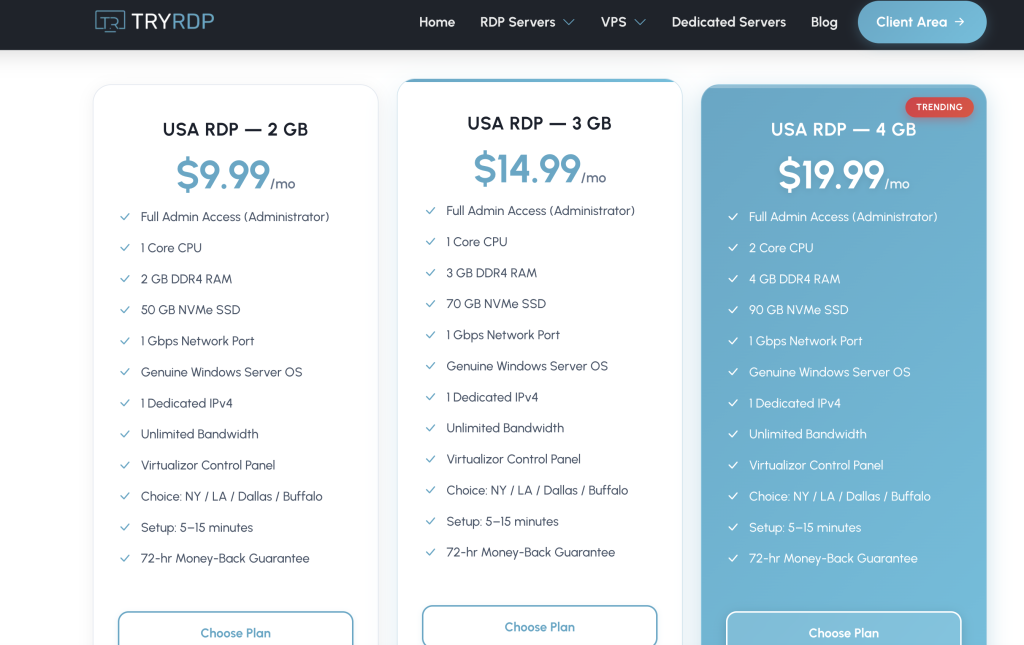
Private RDP provides you with sole access to an individual remote server located in the U.S., unlike Public RDP, where multiple users share a CPU, RAM, and bandwidth on a single remote server. When you rent a private RDP, you have your own dedicated server. This includes having your own IP address assigned to you by the hosting provider. AWS & DigitalOcean share IP addresses among customers.
For example, a developer in Mumbai can remotely connect to their Private RDP located in New York and run automation scripts and keep long-running applications alive without using any resources on their laptop.
What to expect?
- Dedicated CPU, RAM, & SSD disk space
- Full administrator access to install the software you desire
- Speed of 500 Mops to 10Gbs
- Fixed IP address
What is a Residential RDP?
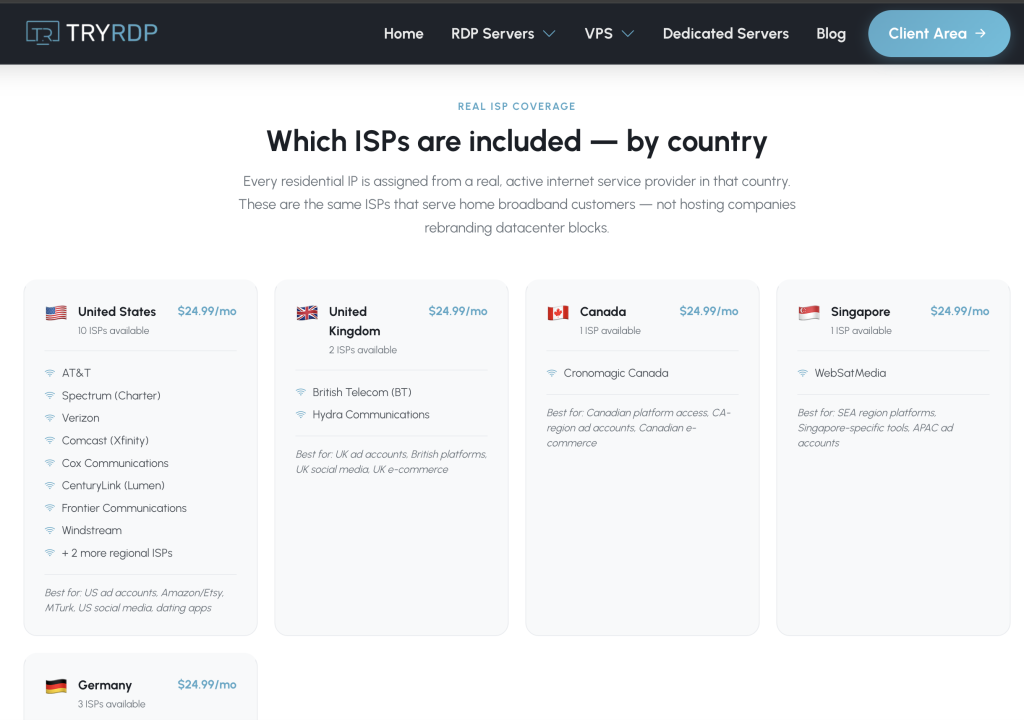
Residential RDP uses an IP address assigned to a legitimate customer( such as Comcast, Jio, BT). Your session will route through this IP address from the ISP’s rack (data center) to create a connection from the data center to your computer through the customer’s IP address.
Example: A marketing agency in London should check local Google search results to identify users residing in Chicago, Illinois. By employing an Illinois Comcast customer’s residential IP address through their RDP service, they can observe it as a typical user in Chicago would, thereby accessing their Google ranking.
What to expect?
- An IP address classified as “Consumer Residential” by ARIN & RIPE databases.
- Trust score of 70+ out of 100
- Accuracy level on geographic radius
- Organic traffic that appears to come from a normal residential user.
Secure sites allow 85%-95% of residential IPs entry, compared to only 60%-80% of data center IPs. In some social media & financial service platforms, the data centre access rates could reach as low as 30%.
How To Decide?
Ask these four questions before making a choice.
- Is there an IP data center limit on this platform?
Use IPinfo.io or Scamalytics as a sample. If the platform is managed by cloud hosting companies( like Cloudflare or Akamai), there will be data center restrictions. If you are logging in from an IP data center, you can rely on Residential RDP.
- Do you have full software control?
If you want to install any application or set properties of an operating system on your RDP server, use Private RDP. Residential RDP is merely an IP routing service, not a complete computer system.
- How much is the speed requirement?
To figure out your speed requirement, consider your video editing requirements, any large file transfers, or any other type of information processing that requires more than 10 to 100 Mbps capacity. For high-bandwidth work, use Private RDP.
- Do you need a static IP?
For work that necessitates multiple logins to the same server, a static IP address is a requirement. For research purposes, changing residential IP addresses is usually more advantageous; however, logging into a sensitive platform multiple times could activate security notifications.
If you are still deciding between dedicated and shared setups, you can refer our guide “Shared RDP Vs Dedicated RDP.
Where Most Buyers Fail?
- Buying an unnecessary Residential RDP. If your purpose is not platform IP screening, the higher cost and reduced speed of Residential RDP offer no response.
- Neglecting the IP pool quality. Not all IP pools have to be clean. Ask your service provider if the IPs are shared or isolated and how often the IP pools are renewed.
- Confusing a residential IP address with anonymity. Residential RDP improves your website’s reputation, but does not provide any privacy from surveillance. Therefore, you need another security measure to achieve privacy. To better understand how residential IPs are sourced and routed, see our detailed breakdown of What Are Residential Proxies?
- Purchasing cheaper residential plans, i.e., less than US$10 monthly. The likelihood of obtaining a recycled or blacklisted IP address is higher.
Price Comparison:
The cost of Private RDP ranges between $5 and $30 monthly, based on your specifications (CPU, RAM, & storage). The cost of Residential RDP is between $20 and $80 monthly; the price includes the cost of the ISP-sourced IP, excluding hardware performance. In fact, a $40 Residential plan may run on a $12 Private plan. Avoid choosing Residential plans below $10 per month, as they may include recycled or blacklisted IPs. For best results, use Private RDP for computing tasks and Residential RDP where there is a need for platform trust.
Final Decision
Select Private RDP if you are looking for development, automation, remote access, and tasks where speed and total control are critical. It will work best for almost all your computing needs at a lower cost.
Use Residential RDP if you have work that is conducted on platforms that track the IP’s origin, e.g., local SEO, social media management, ad verification, or e-commerce accounts.
If your workflows comprise processing with heavy computing requirements & platform-sensitive tasks, use a hybrid combination of Private RDP for processing capabilities and Residential RDP to establish platform trust.
Frequently Asked Questions
Q. How does a private RDP differ from a residential RDP?
A. Private RDP gives you a high-speed, full-control dedicated server located in a data center. Residential RDP sends your traffic via an actual home ISP address, making it appear as a real user to websites and platforms that monitor connection types.
Q. Which is the best option for SEO and local ranking?
A. Residential RDP works better when it comes to tracking SEO and local ranking. Search engines view data center-based IPs differently from home users and may give different results. If your Residential IP is within your target city, it will provide you with accurate and user-representative data.
Q. Will I get blocked while using Residential RDP?
A. Although using a Residential RDP will lower your chance of detection, there are still chances that you might get blocked for certain things, such as using an IP type in combination with automated patterns, occurring at an odd time, or having a large volume of requests.
Q. Why do Residential RDPs cost more than Private RDPs?
A. The cost associated with Residential RDP has more to do with the cost of maintaining a legitimate ISP-sourced IP pool via contract with the carriers, rather than any physical hardware difference. You are paying for the trust you place in the IP address rather than the computing power it has.
Q. Can I mix both types of RDPs?
A. Yes, you can use a combination of a Private RDP for all computing functions and a Residential RDP for only those functions that rely on receiving trust from that platform. This will allow you to have an economical way to access the platforms while not giving up any access level.